Unique Properties of One-Dimensional Materials
We synthesized and investigated MoI3, a van der Waals material with a “true one-dimensional” crystal structure that can be exfoliated to individual atomic chains. Machine learning allowed to establish the existence of MoI3 with 1D crystal structure as opposed to the previously suggested 2D structure.
F. Homrich da Jornada (Stanford), A. A. Balandin, L. Bartels (U. CA – Riverside)
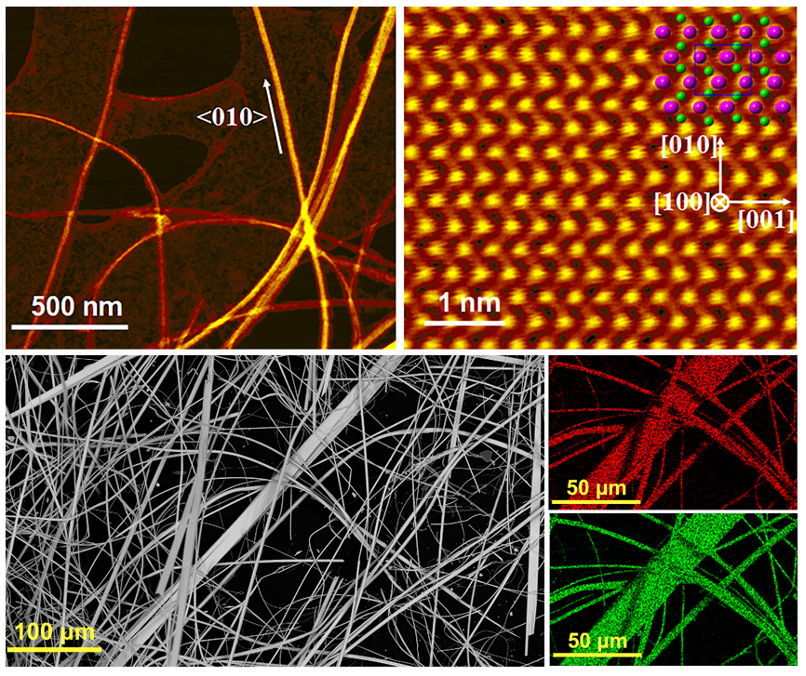
We synthesized and investigated MoI3, a van der Waals material with a “true one-dimensional” crystal structure that can be exfoliated to individual atomic chains.
Machine learning allowed to establish the existence of MoI3 with 1D crystal structure as opposed to the previously suggested 2D structure.
The temperature evolution of Raman spectroscopic features reveals anomalous behavior suggesting a phase transition of magnetic origin.
Theoretical considerations indicate that MoI3 is an easy-plane antiferromagnet with alternating spins along the dimerized chains and with inter-chain helical spin ordering.
The calculated frequencies of the phonons and magnons are consistent with the interpretation of the experimental Raman data.
The obtained results shed light on the specifics of the phononic and magnonic states in MoI3 and provide a strong motivation for further study of this unique material with potential for future spintronic applications.