Hydroxide Diffusion in Anion Exchange Membranes
The development of reliable, cost-effective polymer architectures for use as anion exchange membranes (AEMs) is an important challenge facing emerging electrochemical device technologies.
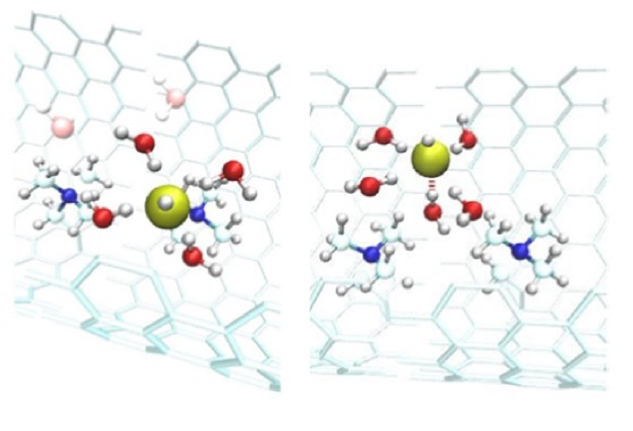
The development of reliable, cost-effective polymer architectures for use as anion exchange membranes (AEMs) is an important challenge facing emerging electrochemical device technologies. Elucidation of key design principles underlying these electrolytes requires a fundamental understanding of the hydroxide ion transport mechanism in the aqueous region of an AEM. Here, a series of atomistic ab initio molecular dynamics calculations has been carried out. To mimic the complex AEM nanoconfined environment, graphane bilayers or carbon nanotubes have been employed to which selected cationic groups are attached and which are subsequently filled with water and hydroxide ions to achieve target water-to-cation ratios and overall electrical neutrality. The complex structure of water under nanoconfinement differs from the bulk and is controlled by the shape and size of the confining volume. Consequently, the local hydroxide ion diffusion mechanisms in different chemical and geometric environments is also seen to differ from that in bulk aqueous solution and depends on a number of design parameters, including hydration level, cation spacing, and cell geometry.