Controlling Quasi-1D Excitons by Magnetic Order

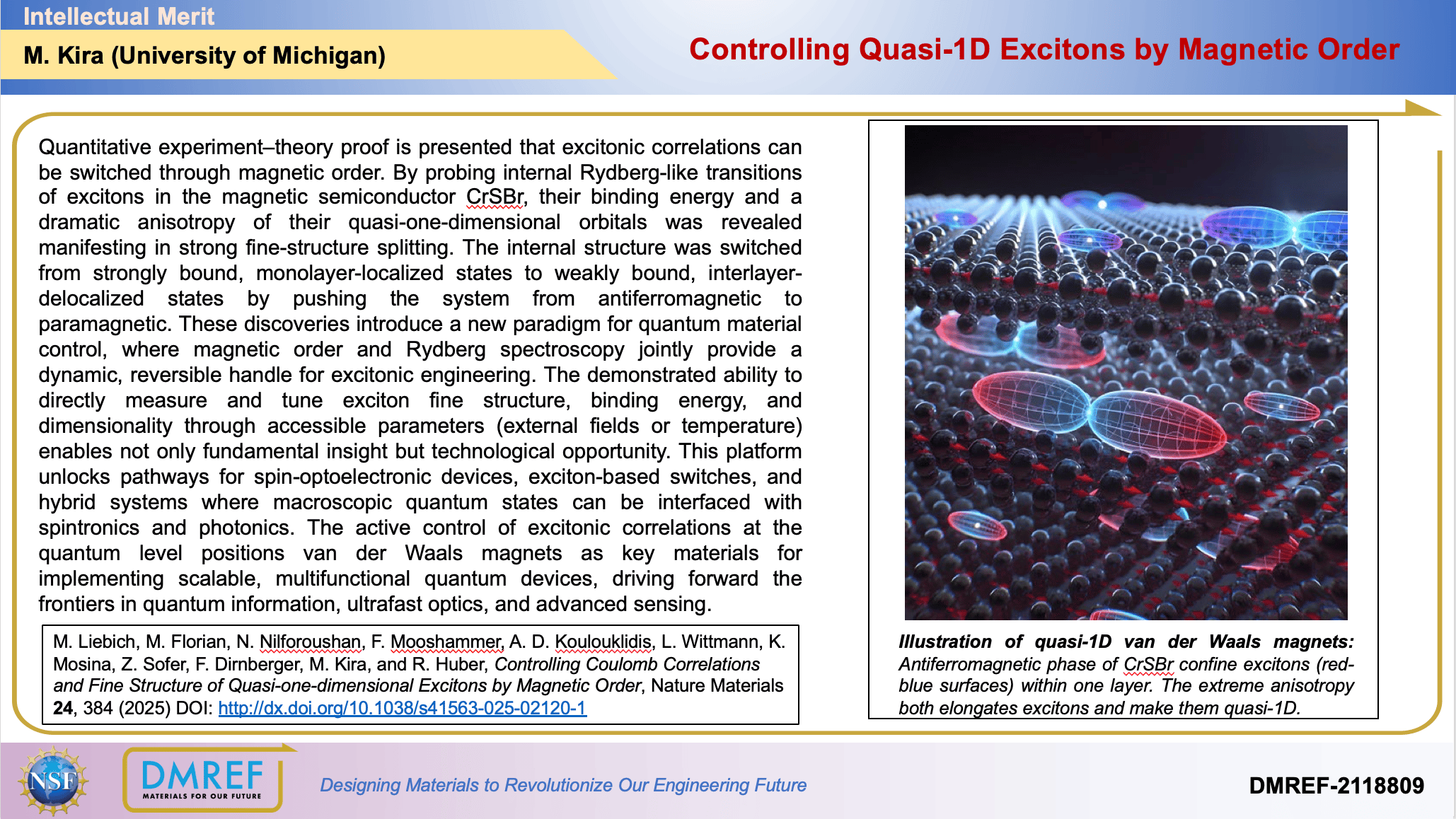
Quantitative experiment–theory proof is presented that excitonic correlations can be switched through magnetic order. By probing internal Rydberg-like transitions of excitons in the magnetic semiconductor CrSBr, their binding energy and a dramatic anisotropy of their quasi-one-dimensional orbitals was revealed manifesting in strong fine-structure splitting. The internal structure was switched from strongly bound, monolayer-localized states to weakly bound, interlayer-delocalized states by pushing the system from antiferromagnetic to paramagnetic. These discoveries introduce a new paradigm for quantum material control, where magnetic order and Rydberg spectroscopy jointly provide a dynamic, reversible handle for excitonic engineering. The demonstrated ability to directly measure and tune exciton fine structure, binding energy, and dimensionality through accessible parameters (external fields or temperature) enables not only fundamental insight but technological opportunity. This platform unlocks pathways for spin-optoelectronic devices, exciton-based switches, and hybrid systems where macroscopic quantum states can be interfaced with spintronics and photonics. The active control of excitonic correlations at the quantum level positions van der Waals magnets as key materials for implementing scalable, multifunctional quantum devices, driving forward the frontiers in quantum information, ultrafast optics, and advanced sensing.