Topological Data Analysis for Particulate Gels

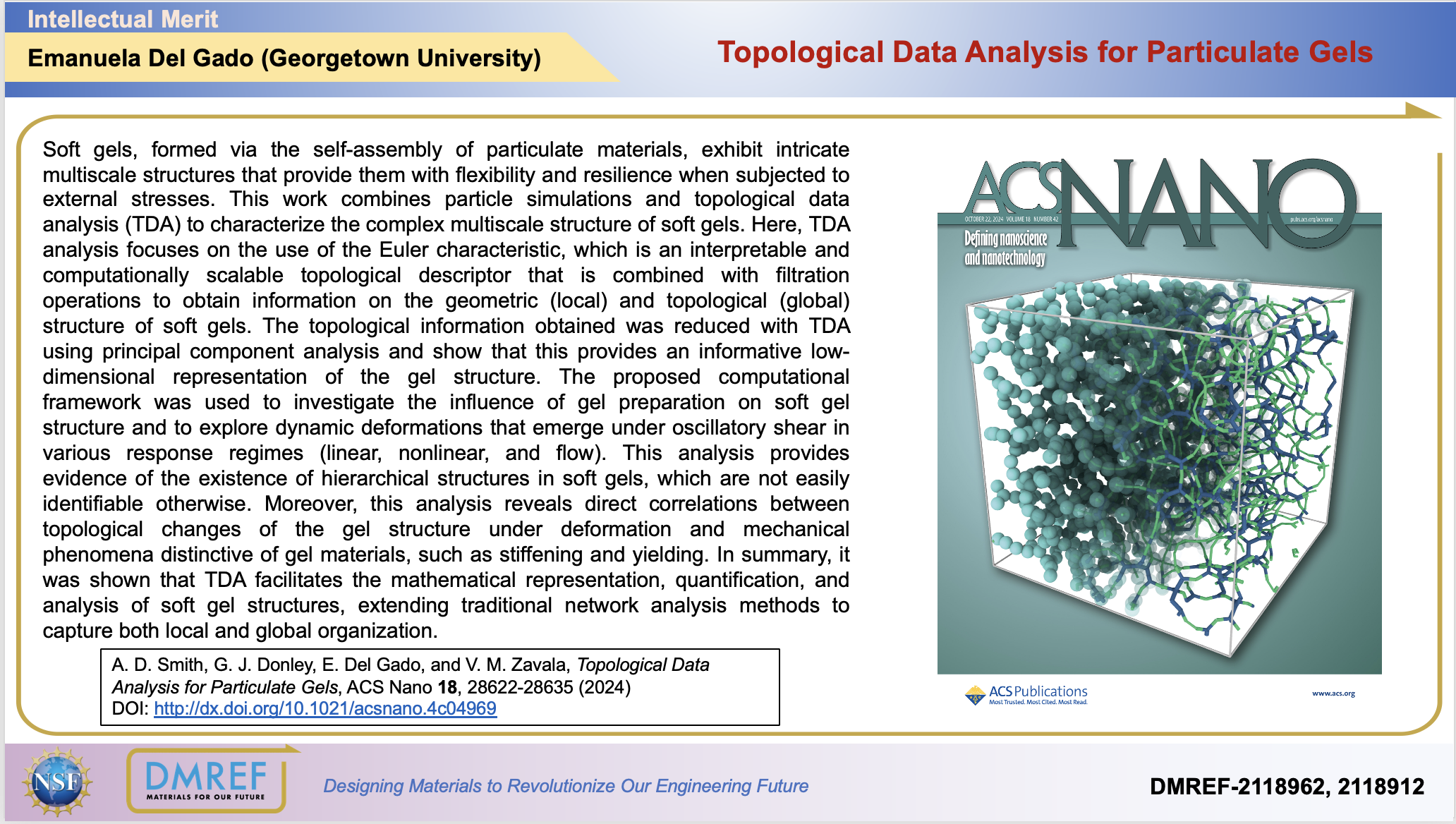
Soft gels, formed via the self-assembly of particulate materials, exhibit intricate multiscale structures that provide them with flexibility and resilience when subjected to external stresses. This work combines particle simulations and topological data analysis (TDA) to characterize the complex multiscale structure of soft gels. Here, TDA analysis focuses on the use of the Euler characteristic, which is an interpretable and computationally scalable topological descriptor that is combined with filtration operations to obtain information on the geometric (local) and topological (global) structure of soft gels. The topological information obtained was reduced with TDA using principal component analysis and show that this provides an informative low-dimensional representation of the gel structure. The proposed computational framework was used to investigate the influence of gel preparation on soft gel structure and to explore dynamic deformations that emerge under oscillatory shear in various response regimes (linear, nonlinear, and flow). This analysis provides evidence of the existence of hierarchical structures in soft gels, which are not easily identifiable otherwise. Moreover, this analysis reveals direct correlations between topological changes of the gel structure under deformation and mechanical phenomena distinctive of gel materials, such as stiffening and yielding. In summary, it was shown that TDA facilitates the mathematical representation, quantification, and analysis of soft gel structures, extending traditional network analysis methods to capture both local and global organization.