Single-layer Clathrane: Potential Superconducting 2D Hydrogenated Metal Borocarbide
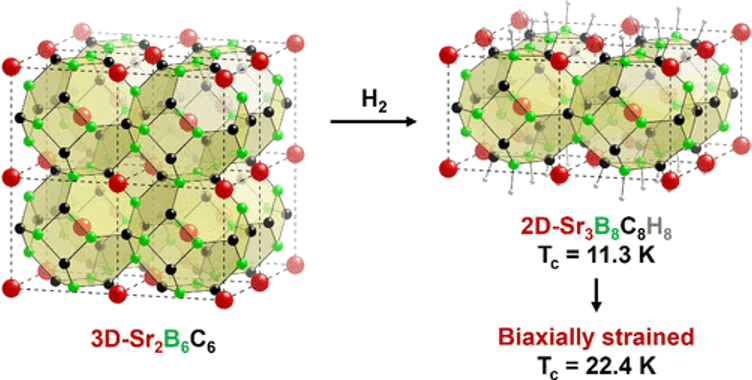
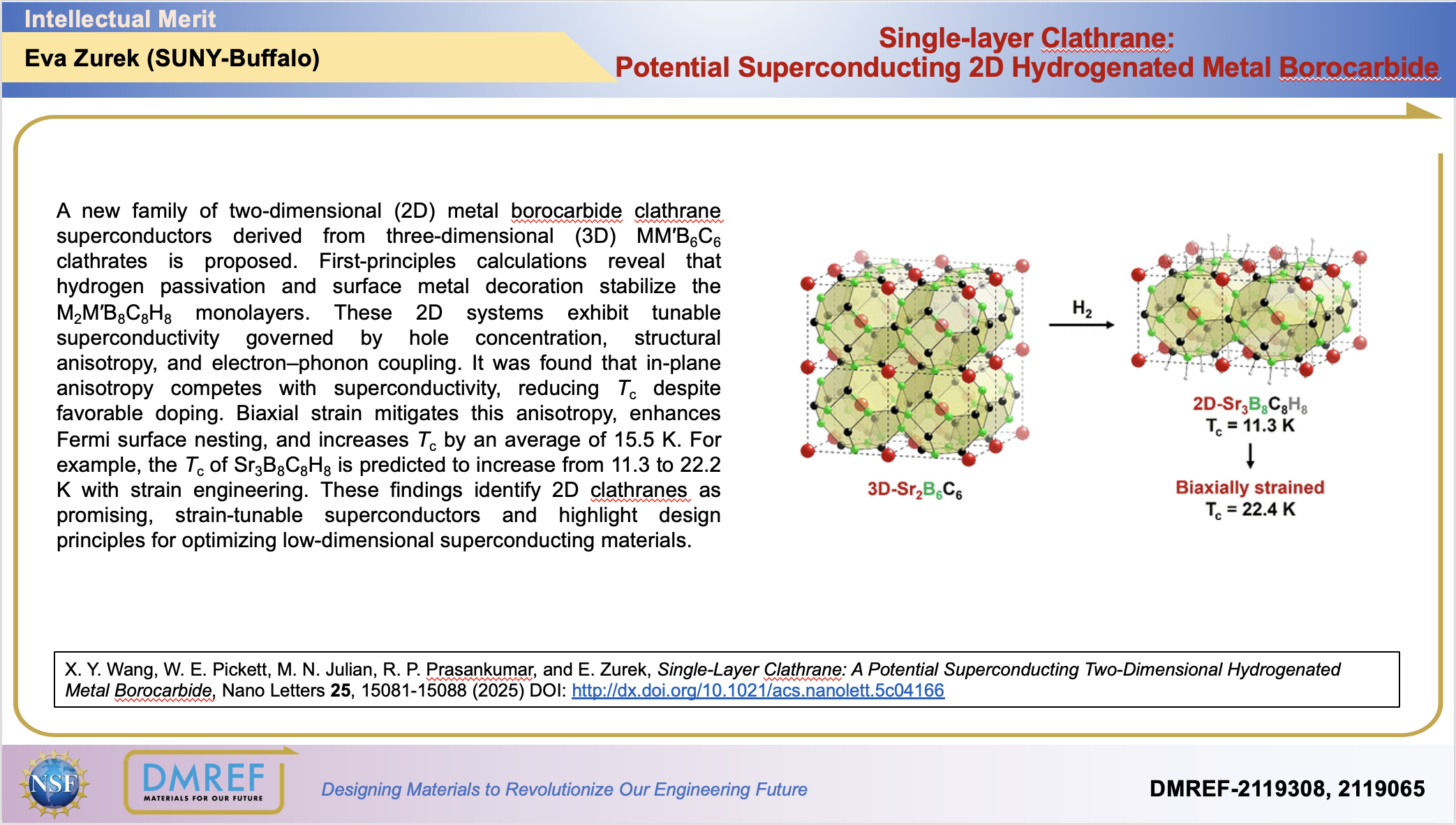
A new family of two-dimensional (2D) metal borocarbide clathrane superconductors derived from three-dimensional (3D) MM′B6C6 clathrates is proposed. First-principles calculations reveal that hydrogen passivation and surface metal decoration stabilize the M2M′B8C8H8 monolayers. These 2D systems exhibit tunable superconductivity governed by hole concentration, structural anisotropy, and electron–phonon coupling. It was found that in-plane anisotropy competes with superconductivity, reducing Tcdespite favorable doping. Biaxial strain mitigates this anisotropy, enhances Fermi surface nesting, and increases Tc by an average of 15.5 K. For example, the Tc of Sr3B8C8H8 is predicted to increase from 11.3 to 22.2 K with strain engineering. These findings identify 2D clathranes as promising, strain-tunable superconductors and highlight design principles for optimizing low-dimensional superconducting materials.