
Controlled 3D Assembly of Graphene Sheets
Mar 6, 2017
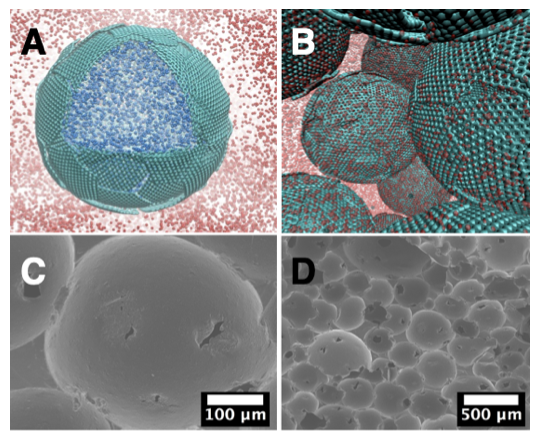
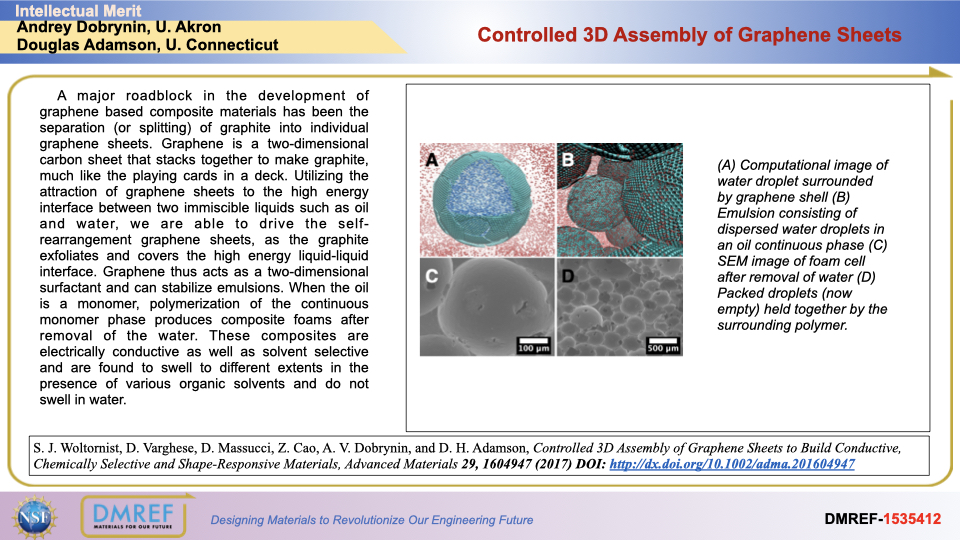
(A) Computational image of water droplet surrounded by graphene shell (B) Emulsion consisting of dispersed water droplets in an oil continuous phase (C) SEM image of foam cell after removal of water (D) Packed droplets (now empty) held together by the surrounding polymer.

A major roadblock in the development of graphene based composite materials has been the separation (or splitting) of graphite into individual graphene sheets. Graphene is a two-dimensional carbon sheet that stacks together to make graphite, much like the playing cards in a deck. Utilizing the attraction of graphene sheets to the high energy interface between two immiscible liquids such as oil and water, we are able to drive the self-rearrangement graphene sheets, as the graphite exfoliates and covers the high energy liquid-liquid interface. Graphene thus acts as a two-dimensional surfactant and can stabilize emulsions. When the oil is a monomer, polymerization of the continuous monomer phase produces composite foams after removal of the water. These composites are electrically conductive as well as solvent selective and are found to swell to different extents in the presence of various organic solvents and do not swell in water. 
Authors

Andrey Dobrynin and Douglas Adamson

Additional Materials

U.S. National Science Foundation and NSF DMREF, Materials for Our Future

This material is based upon work supported by the U.S. National Science Foundation Award No. 2015237. Any opinions, findings, and conclusions or recommendations expressed in this material are those of the author(s) and do not necessarily reflect the views of the U.S. National Science Foundation. This site is maintained collaboratively by principal investigators with NSF DMREF awards, independent of the NSF.