Double Doping of Organic Semiconducting Polymers

•Molecular doping is a crucial tool for controlling the number of charge carriers in organic semiconductors, which in turn tunes the conductivity of the materials.
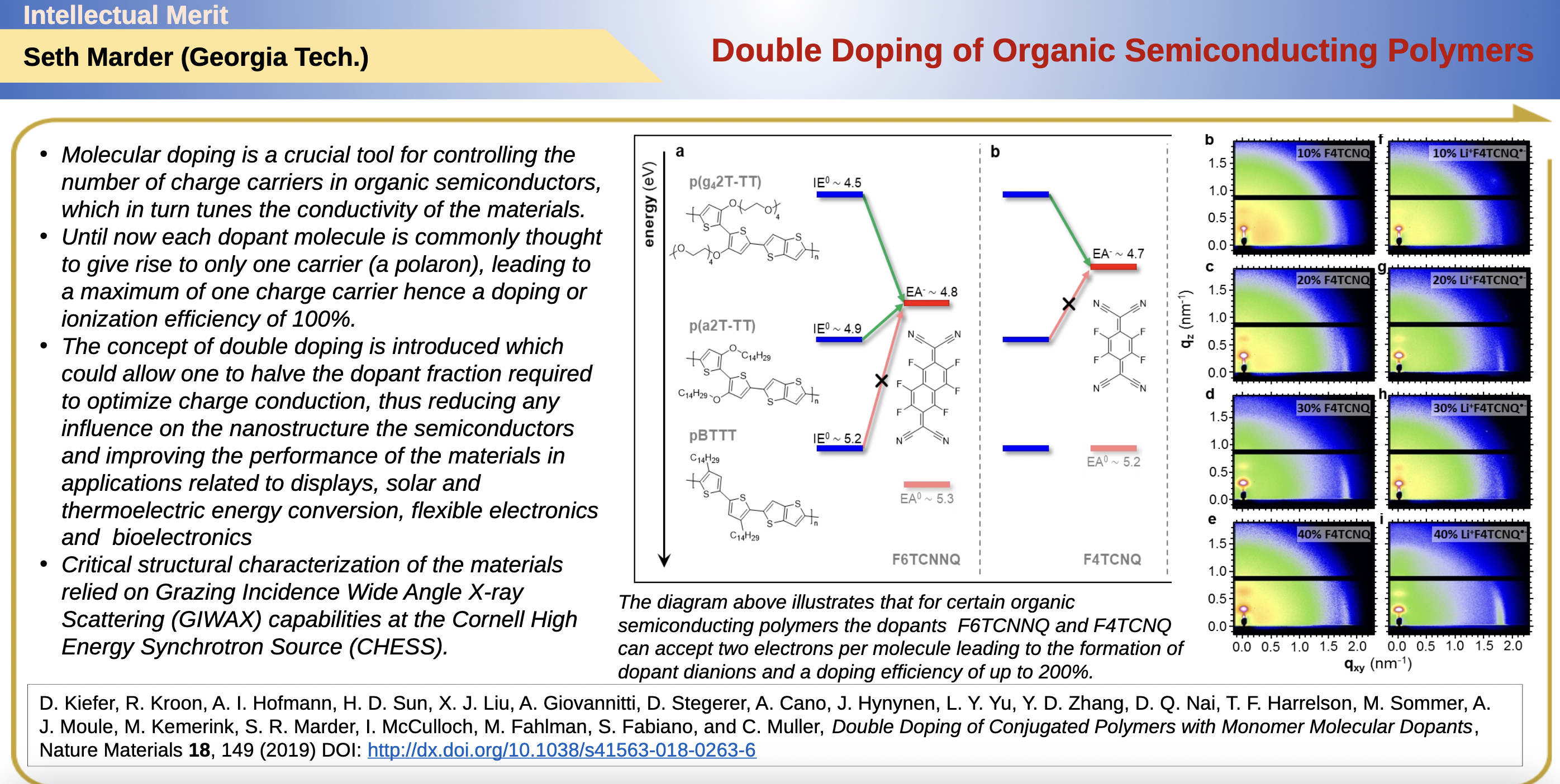
•Until now each dopant molecule is commonly thought to give rise to only one carrier (a polaron), leading to a maximum of one charge carrier hence a doping or ionization efficiency of 100%.
•The concept of double doping is introduced which could allow one to halve the dopant fraction required to optimize charge conduction, thus reducing any influence on the nanostructure the semiconductors and improving the performance of the materials in applications related to displays, solar and thermoelectric energy conversion, flexible electronics and bioelectronics
•Critical structural characterization of the materials relied on Grazing Incidence Wide Angle X-ray Scattering (GIWAX) capabilities at the Cornell High Energy Synchrotron Source (CHESS).