Self-assembled Peptide-p-electron Supramolecular Polymers for Bioinspired Energy Harvesting, Transport, and Management
This project integrates experiment, simulation, and data-science to engineer supramolecular optoelectronic peptidicsemiconductors.
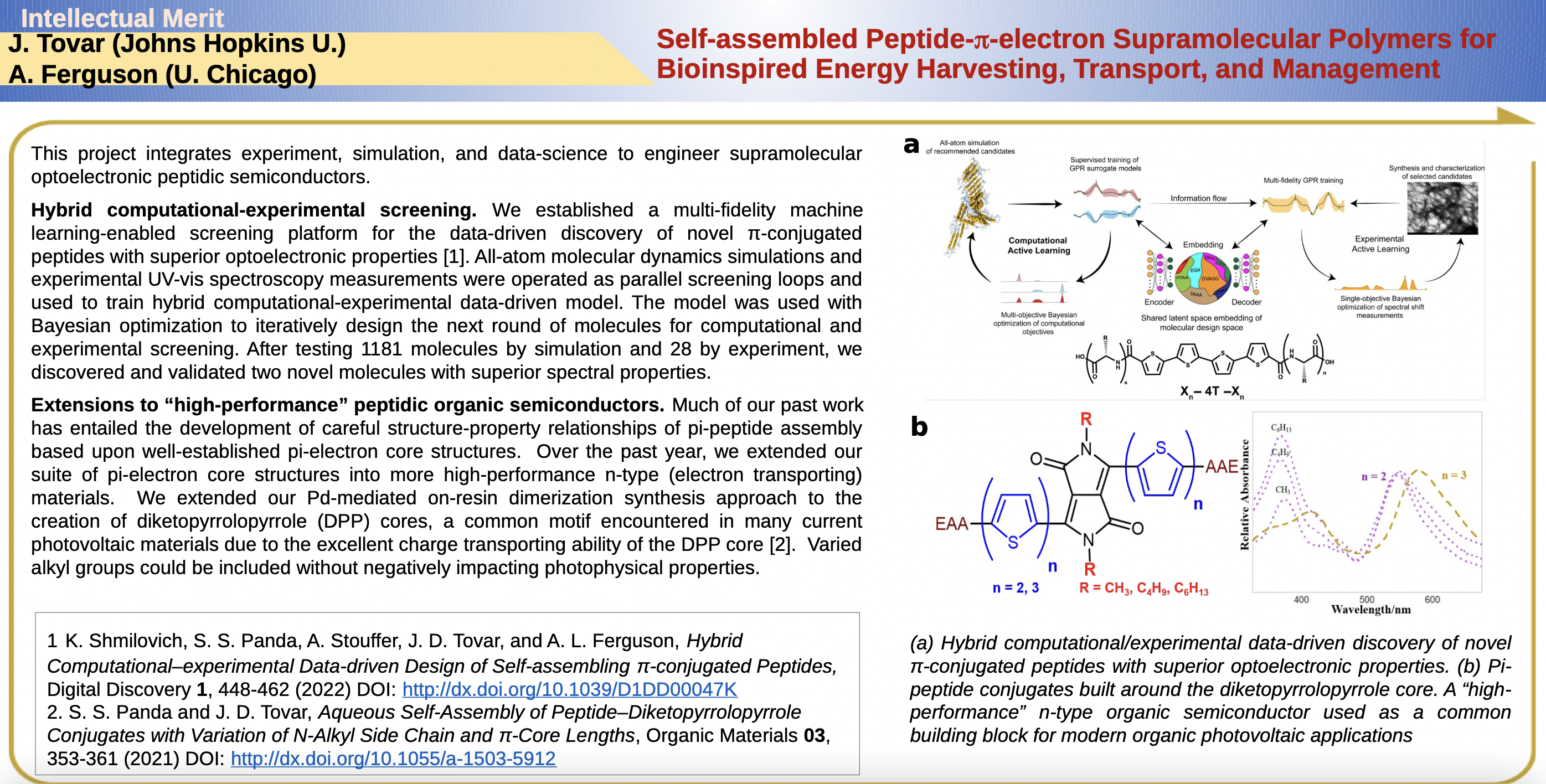
Hybrid computational-experimental screening. We established a multi-fidelity machine learning-enabled screening platform for the data-driven discovery of novel π-conjugated peptides with superior optoelectronic properties [1]. All-atom molecular dynamics simulations and experimental UV-vis spectroscopy measurements were operated as parallel screening loops and used to train hybrid computational-experimental data-driven model. The model was used with Bayesian optimization to iteratively design the next round of molecules for computational and experimental screening. After testing 1181 molecules by simulation and 28 by experiment, we discovered and validated two novel molecules with superior spectral properties.
Extensions to “high-performance” peptidic organic semiconductors. Much of our past work has entailed the development of careful structure-property relationships of pi-peptide assembly based upon well-established pi-electron core structures. Over the past year, we extended our suite of pi-electron core structures into more high-performance n-type (electron transporting) materials. We extended our Pd-mediated on-resin dimerization synthesis approach to the creation of diketopyrrolopyrrole (DPP) cores, a common motif encountered in many current photovoltaic materials due to the excellent charge transporting ability of the DPP core [2]. Varied alkyl groups could be included without negatively impacting photophysical properties.
Hybrid computational/experimental data-driven discovery of novel π-conjugated peptides with superior optoelectronic properties.
Pi-peptide conjugates built around the diketopyrrolopyrrole core. A “high-performance” n-type organic semiconductor used as a common building block for modern organic photovoltaic applications