Superconductivity in Twisted Trilayer Graphene
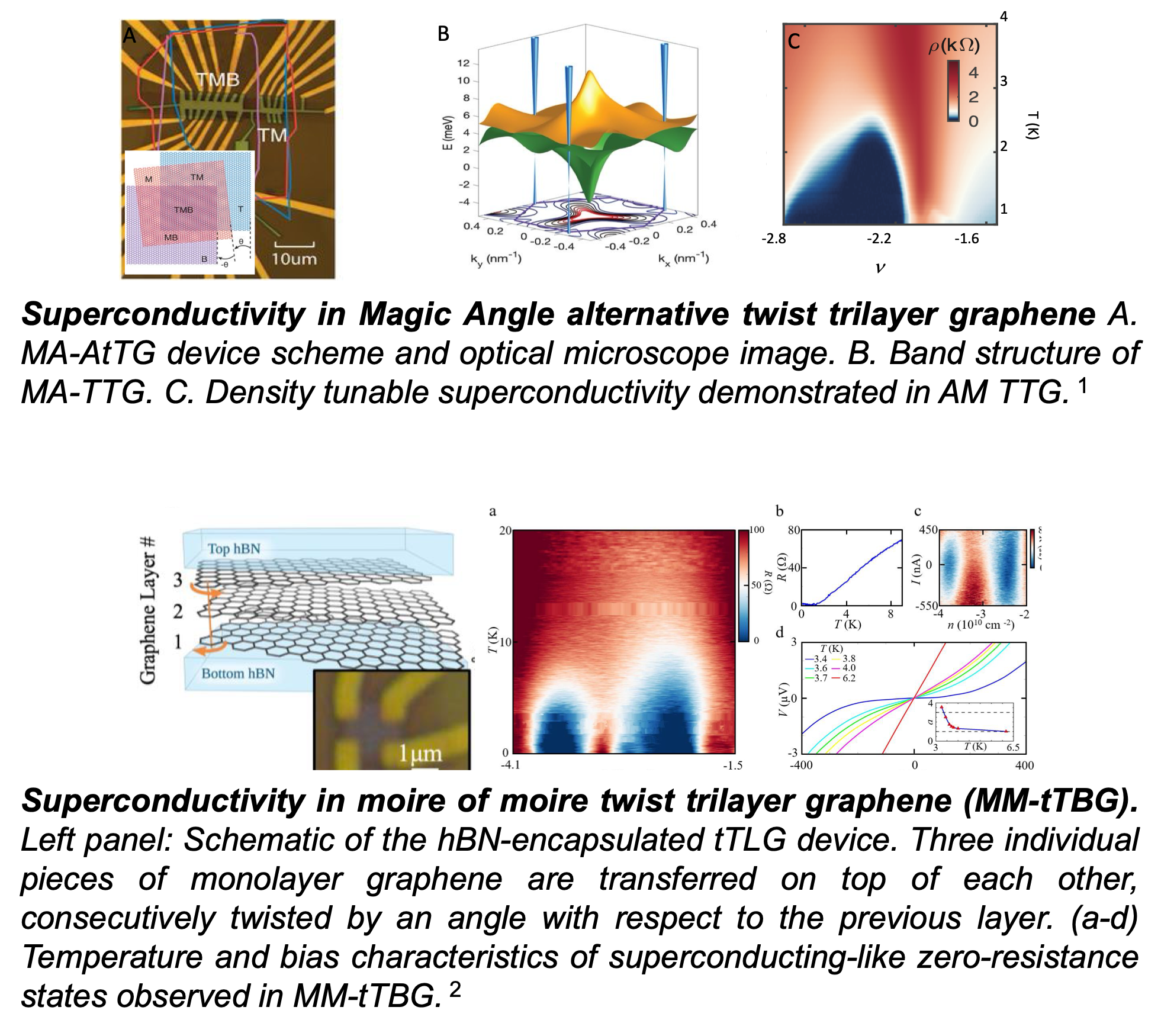
Layers of two-dimensional materials stacked with a small twist angle give rise to beating periodic patterns on a scale much larger than the original lattice, referred to as a ‘moiresuperlattice’. Superconductivity and correlated insulator states in magic angle alternatively twisted trilayer graphene (MA-tTG)1 (Fig., top) and ‘moire of moire’ twisted trilayer graphene (MM-tTG)2 (Fig., bottom) have now been experimentally demonstrated. Initially a van der Waals heterostructure was constructed that consisted of three graphene layers stacked with alternating twist angles. At a theoretically predicted ‘magic angle’ of -1.56° flat electron bands formed with displacement field-tunable superconductivity observed with a maximum critical temperature of 2.1 K.1 Subsequently, a twisted trilayer graphene system with two independently controlled twist angles was fabricated. Correlated insulating states were found near the half filling of the MM-tTG superlattice at an extremely low carrier density, near which was observed a zero-resistance transport behavior at 3.4 K typical of a 2D superconductor.2Together, these findings provide deep understanding of moiré correlated states and unusual superconductivity, which could be utilized for quantum information processing computing platforms.