A New Pathway to Stable, Low-cost, Flexible Electronics
Solution processed organic field effect transistors can become ubiquitous in flexible optoelectronics. While progress in material and device design has been astonishing, low environmental and operational stabilities remain longstanding problems obstructing theirimmediate deployment in real world applications.
Here, a strategy was introduced to identify the most probable and severe degradation pathways in organic transistors and then implement a method to eliminate the main sources of instabilities. Real time monitoring of the energetic distribution and transformation of electronic trap states during device operation, in conjunction with simulations, revealed the nature of traps responsible for performance degradation.
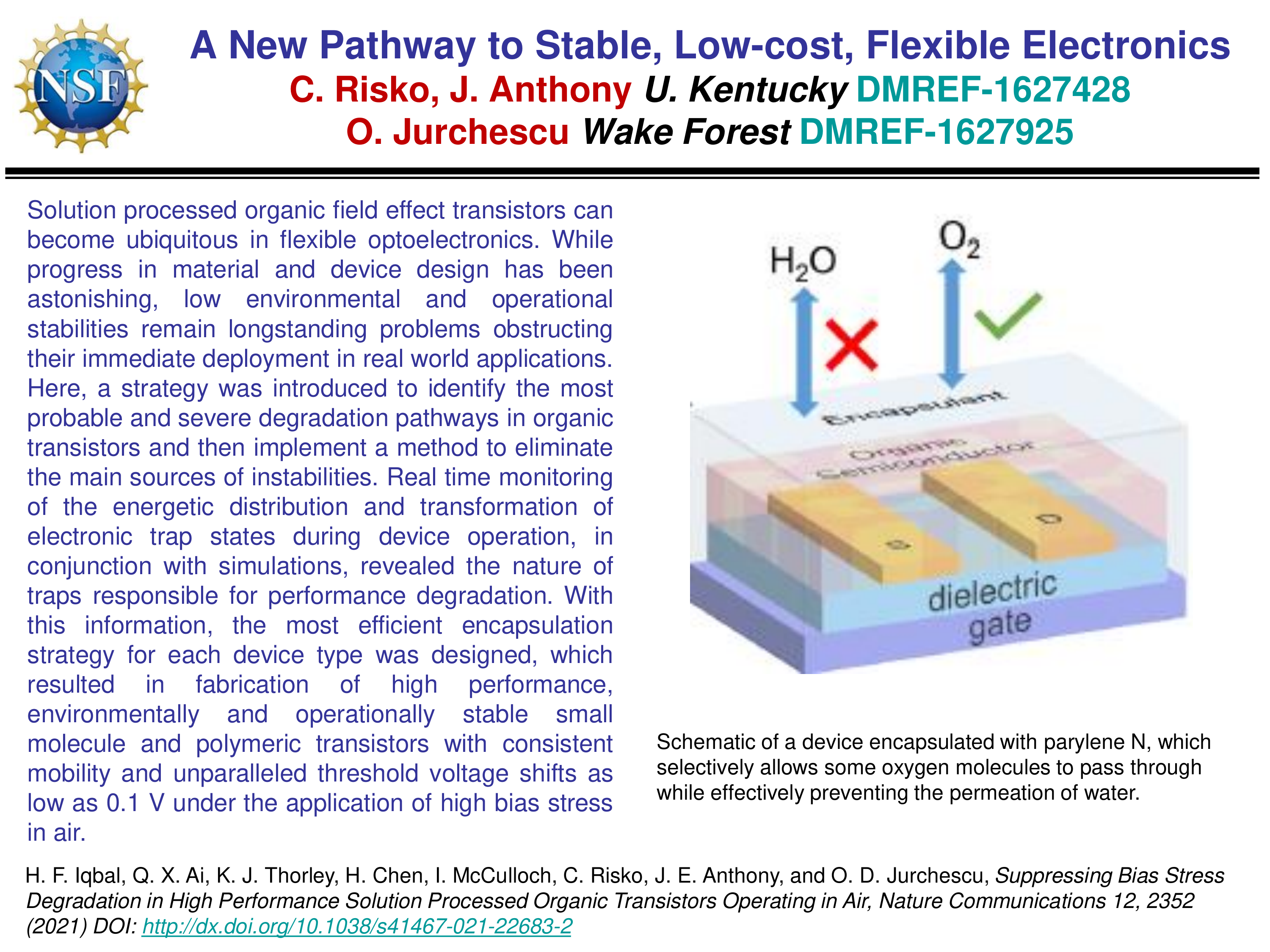
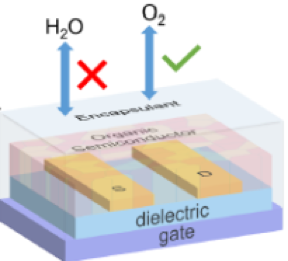
With this information, the most efficient encapsulation strategy for each device type was designed, which resulted in fabrication of high performance, environmentally and operationally stable small molecule and polymeric transistors with consistent mobility and unparalleled threshold voltage shifts as low as 0.1 V under the application of high bias stress in air.